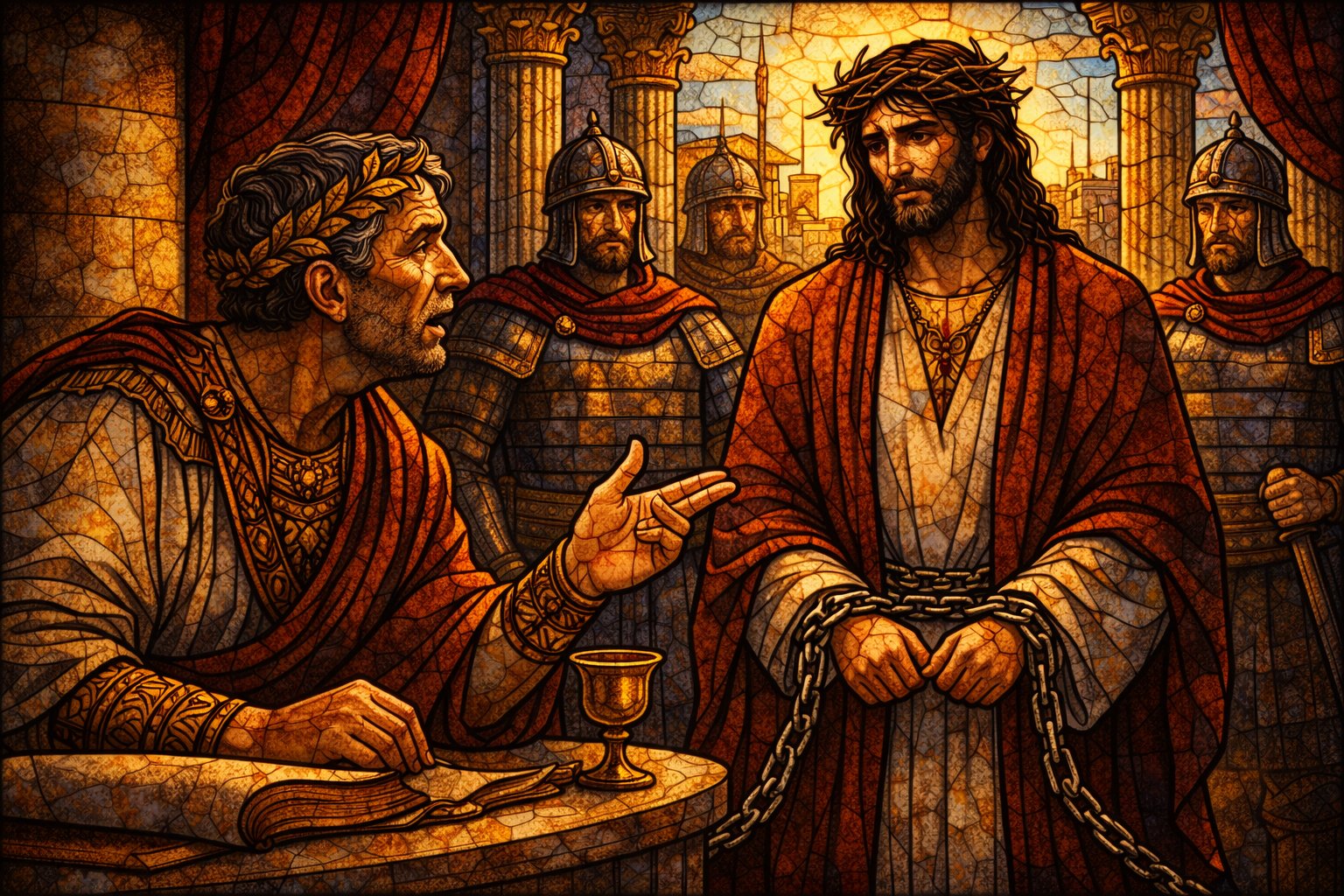
“‘Where do you come from?’ he asked Jesus, but Jesus gave him no answer. ‘Do you refuse to speak to me?’ Pilate said. ‘Don’t you realize I have power either to free you or to crucify you?’” (John 19:9-10)
“We have no king but Caesar,” the chief priests answered. (John 19:15)
As the Jews lacked the judicial agency to deal out the death penalty, the temple authorities bring Jesus to Pontius Pilate, the governor of Judea. At first, Pilate is detached, almost annoyed. He attempts to dismiss the crowds, “Take him yourselves and judge him by your own law.” He unenthusiastically yields to the crowds’ demands by bringing Jesus into his palace for a proper examination.
Jesus is less than cooperative – perhaps even indifferent himself. Pilate directly questions him: “Are you the king of the Jews?” Jesus responds aslant: “Is that your own idea, or did others talk to you about me?” Without fear or false bravado, Jesus adds: “My kingdom is not of this world.” The back and forth between the two of them sends Pilate into amazement: “Don’t you realize I have power either to free you or to crucify you?”
Jesus’s answer: “You would have no power over me if it were not given to you from above.”
He is utterly unafraid. While Pilate’s initial indifference gives way to total fear (John 19:8) of the crowds, Jesus remains unmoved. Even now his reign is unopposed and inevitable (Psalm 2:6). The Father’s plan, purposes, and power cannot be undone. The hatred of the crowds only achieves their own murderous frenzy.
Pilate pleads with the man repeatedly in the hopeless quest to spare his life. Recant, apologize, clarify your comments! Jesus entertains none of it. Perhaps we begin to see what Jesus is seeing when we consider what this scene reveals: though the world has put up with Jesus as an itinerant teacher, though it has suffered his challenging and provocative teachings, it will not tolerate him as king.
Though Christ is deserving of being universally worshipped, the crowd is united in nothing but hatred. Will it not be the same for those who follow him? It is not a matter of being more Christlike, for Christ reminds us: “If the world hates you, keep in mind that it hated me first” (John 15:18). What is true of the Jews is true for the rest of the world. The entire Old Testament has built up to the revelation of the rightful Messiah – and when Pilate declares: “Here is your king!” all that can be heard are the crowds’ cries of rejection: “Take him away! Take him away! Crucify him!”
Though they have claimed to be God’s own people, they will suffer no king but Caesar (John 19:15).