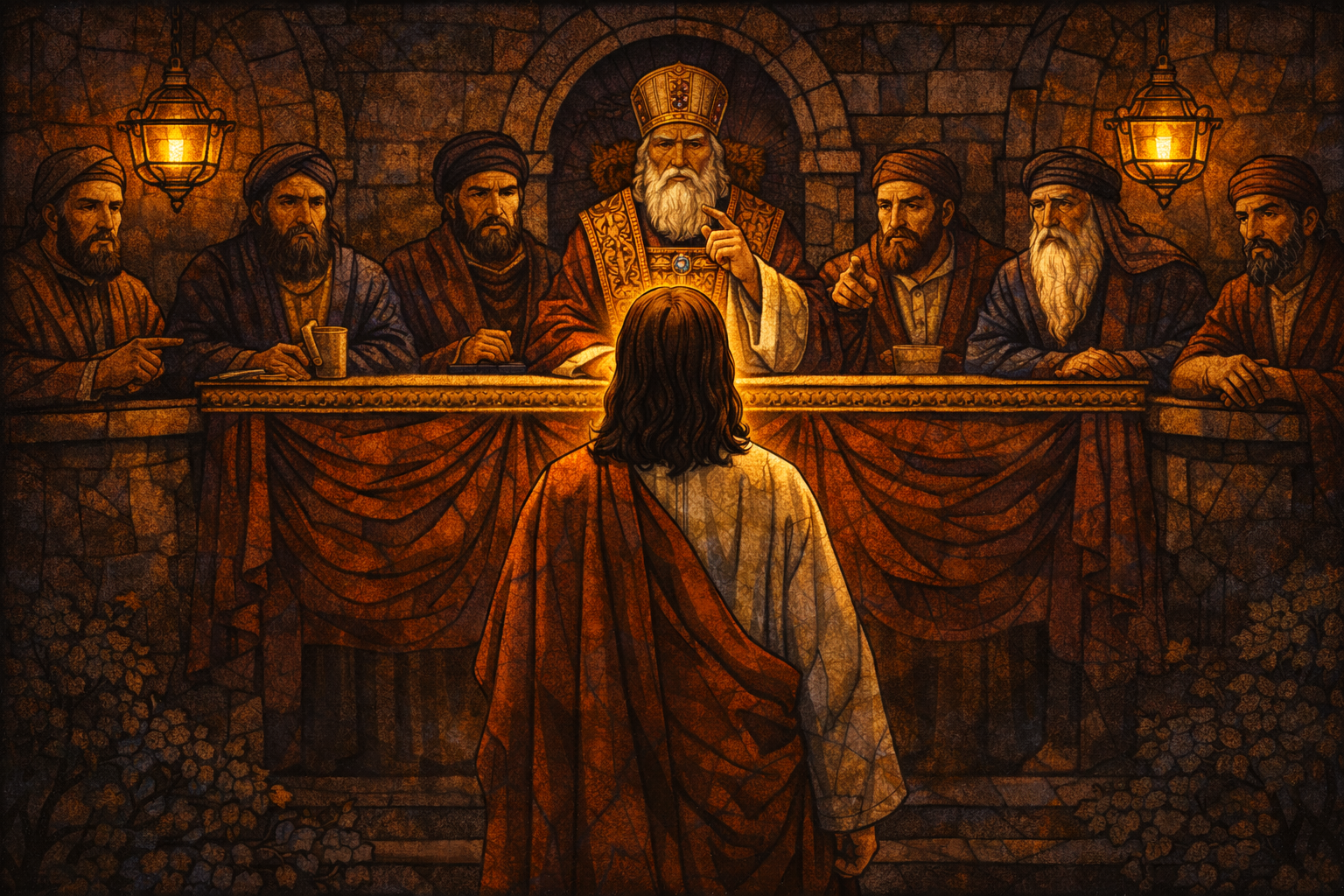
“Then the high priest stood up and said to Jesus, “Are you not going to answer? What is this testimony that these men are bringing against you? But Jesus remained silent.” (Matthew 26:62-63)
Jesus is brought before the Sanhedrin, the ruling Jewish council. Peter follows at a distance, perhaps in the belief that he has not yet technically broken his promise to “never leave” Jesus (Matthew 26:33). The trial is a sham from the start, as the “whole Sanhedrin [was] looking for false evidence against Jesus so that they could put him to death” (Matthew 26:59). Yet, they are unable to find any until two witnesses come forward and testify that Jesus plotted to destroy the temple (v. 61).
Jesus “[remains] silent” (v. 63) despite their accusations against him. Despite the narrative that is spun around him, Jesus is totally unconcerned with clearing his name. He recognizes there is nothing to gain in appealing to men who “loved darkness” (John 3:19). There is no appeal to men who hate the truth.
What point is there in arguing against liars (John 8:44)?
And yet, these liars are deciding Jesus’s fate. How is Jesus able to so peacefully accept this? He doesn’t even appeal to Peter, whom he could call as a witness to clear his name. He allows being painted by an untrue narrative, convicted by a sham trial, defamed and degraded by their accusations and their slander. It is not that they will kill him because he is a blasphemer, but rather they will call him a blasphemer in order to kill him.
How is it possible that he is silent “as a sheep before its shearers is silent” (Isaiah 53:7)?
Don’t we all clamor and complain when we are the target of injustice and lies? Even at a young age we learn how to spin a story in our favor and at another’s expense. We are seized by the need to clear our name and to tarnish another’s. It is both impulsive and instinctive, wrapped up in our original sin.
“The woman you put here with me – she gave me some fruit from the tree, and I ate it” (Genesis 3:12).
Unlike Adam, Jesus receives the accusation without complaint. While it is human to fight to win public opinion, Jesus is only ever concerned with Heaven’s decree. He knows he will one day be vindicated by the Father who does not overlook any evil, and whose wrath is perfectly just (Romans 12:19). He has fully received the declaration over him by the Father: “This is my Son, whom I love; with him I am well pleased” (Matthew 3:17). Jesus holds to these words, or is rather held by them.
The man who needs the room’s approval cannot afford to be silent. But the man who has received the Father’s verdict has nothing left to prove.